
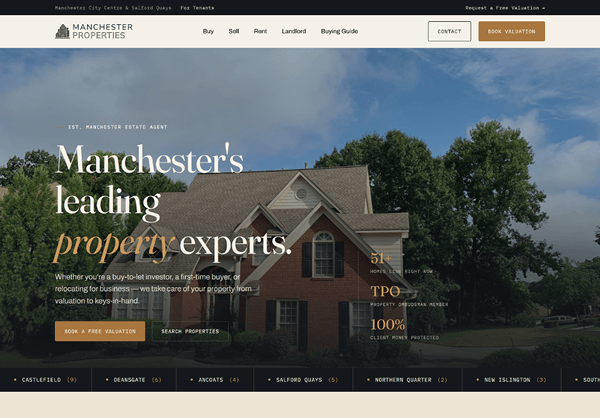
A few days ago I tested an AI generated website design tool with a simple brief : “property consultancy website, UK based, editorial feel, warm and trustworthy.” Within a couple of minutes, I had a homepage that honestly looked better than most agency sites I’ve seen actually launched.
A big hero image of a house at golden hour. A confident serif headline — “Manchester’s leading property experts.” Trust badges, a property grid with real-looking listings, a four-step “how it works” section, a dark closing CTA block. It looked like something a design studio would charge a few thousand pounds for.
And that’s exactly the problem I want to talk about.
Why an AI generated website design isn’t a real website
What these tools hand you back is, in most cases, a static export — an image, or at best a rigid HTML shell with no real backend, no CMS, and no thought given to how a search engine or an actual visitor is going to use it. It’s a screenshot of a website, not a working one.
That distinction matters a lot more than people realise once they’ve fallen in love with the design and are ready to put it live.
Why static AI output falls flat on SEO
I work in SEO and WordPress every day, so this is the part I notice first.
No real heading structure. A design tool doesn’t know or care that “Manchester’s leading property experts” should be an H1, or that your section titles should follow a logical H2/H3 hierarchy. Visually it’s fine. Structurally, Google sees nothing usable.
No alt text, no meta titles, no meta descriptions. These AI exports are built to look good in a browser preview, not to be crawled. There’s nothing whispering to Google what each image or page is actually about.
No indexable content. If the output is image-based or locked inside a design tool’s own hosting, there’s often very little real, crawlable text on the page at all — which means there’s next to nothing for Google to rank.
No page speed thinking. Big unoptimised hero images, no lazy loading, no compression — all things that quietly kill your Core Web Vitals before the site has even had a chance.
No schema, no sitemap, no technical foundation. The stuff that helps a property business show up for “estate agent near me” or get rich results in search simply isn’t there.
You can have the most beautiful homepage in your city and still be invisible on page four of Google, because none of the groundwork was ever laid.
Why it’s not client-friendly either
This is the part that gets missed even more often.
Say you’re an agency, or a business owner, and you’ve generated this design. Great — now what? Most AI tools don’t give you a proper content management system. There’s no dashboard where a client can log in and update a property listing, swap a photo, or edit a price without touching code.
That means every small change goes back through you, or through a developer, forever. No self-service. No easy handover. No “I’ll just pop in and update this myself” for the client. For a property business specifically — where listings change weekly — that’s not a minor inconvenience, it’s a dealbreaker.
There’s also the trust issue. Agencies white-labelling this kind of work for their own clients can’t hand over a static export and call it a finished product. Clients expect a real, editable, ownable website — not a picture they’re locked out of.
So what actually needs to happen
This is where the AI-generated design earns its keep — as a starting point, not an end point.
What I do is take exactly this kind of output — the layout, the typography choices, the colour system, the overall feel the AI got right — and rebuild it properly in WordPress. That means:
Semantic, accessible HTML with a correct heading hierarchy
Full on-page SEO — meta titles, descriptions, image alt text, internal linking, schema markup
A proper CMS setup so the client (or their team) can edit listings, pages, and content without ever opening a code editor
Optimised images and clean code so the site is actually fast, not just fast-looking in a preview
Responsive behaviour that’s been checked and coded for mobile and tablet, not just guessed at
The design intuition of AI is genuinely useful — it’s fast at exploring layout ideas and can get you 70% of the way to something that looks right. But the last 30%, the part that makes a website actually rank, actually load fast, and actually be usable by the person running the business — that still needs a person who understands code and search.
Where I fit in
This is essentially the whole reason I offer AI-design-to-WordPress conversion as a service. Someone generates a design in one of these tools — or I do it for them as a starting point — and I take it from “looks like a website” to “is one”: coded properly, optimised for search, and handed over in a CMS the client can actually use.
If you’ve generated a design like this and you’re wondering what to do with it next, that’s exactly the gap I fill. I’ll help you turn your static AI-generated design into a real, dynamic WordPress website — with solid on-page SEO and a user experience that actually engages visitors, not just looks good in a preview.
You can see examples and get in touch on my AI website templates page.