
Every week I get a message that starts more or less the same way: “I built my website with Bolt / Lovable / v0 / Framer AI, it looks amazing, but I have no idea how to add a blog post” or “Google isn’t showing my site anywhere.” Six months ago that same person was thrilled. Their AI tool spat out a beautiful, modern design in an afternoon. No developer, no waiting, no invoice. Then reality set in.
Here’s the uncomfortable truth nobody tells you before you generate that first prompt: a beautiful AI-generated website and a website that actually grows your business are two different things. And the gap between them is almost always SEO, content, and the ability to change anything without opening a code editor.
The AI Website Honeymoon Phase
Tools like Bolt, v0, Lovable, Framer AI, and Relume have genuinely changed how fast a site can go from idea to a live URL. You type a prompt, describe your business, and within minutes you’re looking at a polished landing page with a hero section, service cards, testimonials, and a contact form. For a portfolio, a quick MVP, or a proof of concept, that speed is genuinely useful.
The problem shows up about 60–90 days later, right around the time a business owner realizes:
- They can’t add a new blog post without asking someone to touch the code.
- Their meta titles and descriptions are either missing or generic and were never written for search intent.
- There’s no way to update a price, swap a testimonial, or add a new service without a developer.
- Google has indexed maybe two or three pages, and rankings haven’t moved.
- The site technically “exists,” but it isn’t doing any actual marketing work.
This isn’t a knock on the AI tools themselves. They’re excellent at what they’re built for: fast, static, front-end code. What they’re not built for is being a living, breathing content engine that a non-technical business owner can manage for the next five years.
Why Static AI Sites Struggle With SEO Specifically
1. No Content Management Means No Fresh Content
Search engines reward sites that are actively maintained. A blog, updated service pages, new case studies, and seasonal landing pages tell Google (and your visitors) that a business is active and worth trusting. An AI-generated static site is usually a fixed set of hardcoded pages. Adding a new page means editing code, not clicking “Add New Post.” Most owners simply never do it, and the site freezes in time from launch day.
2. Meta Data and Technical SEO Are an Afterthought
AI page builders are optimized to produce something that looks right, not something that’s structured for search. Titles, meta descriptions, header hierarchy (H1, H2, H3), image alt text, and schema markup are the details search engines actually read. In most AI-generated exports, they’re either missing, duplicated across pages, or generated as filler text with little relevance to real search intent.
3. No Easy Way to Iterate Based on Data
SEO isn’t a one-time setup. It’s an ongoing process of testing headlines, adjusting page structure, adding internal links, and expanding thin content into something more authoritative. On a static, code-based site, every one of those small but important changes requires a developer. In practice, that friction means the improvements never happen.
4. The Owner Becomes Dependent on Whoever Built It
This is the part that quietly costs businesses the most. If updating your website requires contacting a developer every time, you’ll only make changes when something breaks—not when there’s an SEO or marketing opportunity. A website should empower the owner to act quickly. A static AI export usually does the opposite.
What Actually Changes When You Move to Dynamic WordPress
I’ve spent a good part of the last year converting AI-generated designs from Bolt, v0, Lovable, Framer AI, and Relume into fully dynamic WordPress websites, usually built with Elementor so the visual design is preserved exactly. The appearance doesn’t change. What changes is everything happening behind the scenes.
Here’s a real example from a recent project—a UK-based aesthetics clinic. The design below started as an AI-generated static export:
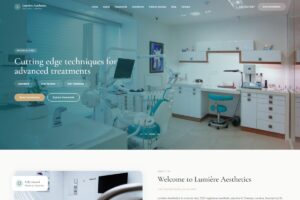
The original AI-generated static page—great visual design, but a fixed, hardcoded layout with no way to manage content.
And here’s the same design rebuilt as a fully dynamic WordPress + Elementor website:
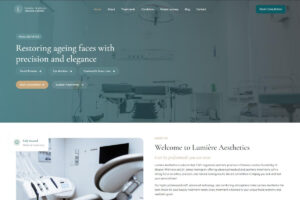
The converted WordPress version—identical design, but now every section, image, testimonial, and treatment card is editable, and the site has a real CMS behind it.
Visually, they’re nearly indistinguishable. That’s the point. The client didn’t lose the design they paid for. What they gained is what was missing the whole time:
- A real CMS. New blog posts, treatment pages, or testimonials can be added by anyone on the team in minutes, without writing code.
- Proper on-page SEO. Every page gets optimized titles, meta descriptions, clean heading structures, and image alt text.
- Editable everything. Prices, service descriptions, team bios, opening hours, and more can all be updated through Elementor.
- A foundation built to scale. Adding new pages, locations, or services doesn’t require rebuilding the site.
- Plugin ecosystem. SEO, performance optimization, security, forms, analytics, and countless other features are readily available.
Static Isn’t “Bad.” It’s Just Incomplete.
I want to be fair to the AI tools because they’re not the villain. They solve the first 80% of the problem extremely well: turning an idea into a polished website quickly. What they weren’t designed to handle is the next five years of the website’s life—the blog posts, ongoing edits, SEO improvements, new service pages, and seasonal campaigns.
Think of it like the difference between a beautifully staged show home and an actual house someone lives in. The show home looks perfect on opening day, but nobody can cook, store belongings, or truly make it their own. A dynamic CMS transforms that show home into a place that grows with your business.
The Real Cost of Staying Static
If you’re running an AI-generated static website today, every month it remains static is another month without new blog content, service pages, or SEO improvements. Meanwhile, competitors using WordPress or another proper CMS continue publishing, updating, and improving their search rankings. SEO compounds over time. A website that never changes never compounds its results.
Converting your site doesn’t mean throwing away the design you’ve already invested in. It means keeping everything you love visually while adding the engine needed to make it perform.
If your site was built with Bolt, v0, Lovable, Framer AI, or Relume and you’re finding it difficult to update, impossible to blog on, or nearly invisible to Google, that’s not a problem to leave for later. It’s one of the biggest opportunities to improve your SEO and transform your website from a static brochure into a genuine marketing asset.
I convert AI-generated designs into fully dynamic, SEO-ready WordPress websites, keeping the design intact while giving you full control over content, structure, and search performance. You can see how the process works here: AI to WordPress